You could eat a genuinely good diet, sleep eight hours most nights, and still spend January feeling like you're running on sixty percent — and vitamin D would be the last thing you'd suspect. That's because your body makes most of its supply from a reaction that happens in your skin when direct sunlight hits it, not from anything you swallow at breakfast. By late autumn across most of the UK and the northern half of the US, the sun sits too low in the sky for that reaction to work at all, sometimes for five or six months straight. Add an office job, a car commute, and the daily sunscreen habit most women were told to build in their twenties, and the maths gets worse fast. Roughly one in three US adults and around one in six UK adults have blood levels low enough to count as deficient, and the ratio skews toward women in nearly every study that has tracked it by sex. None of this shows up as one dramatic symptom — it shows up as everything feeling slightly harder than it should.
Why Women Run Low More Than Men Do
Several factors compound specifically for women, and most of them are habits nobody frames as vitamin-related. Sunscreen with SPF 30 blocks around 97 percent of the UVB rays skin needs to synthesise vitamin D, and dermatologists have spent three decades — correctly — telling women to wear it daily on the face and any exposed skin. Women also report spending more time indoors across the average week than men in several time-use surveys, whether that's a desk job, the school run, or simply choosing an indoor class over a run outside. Skin tone matters too: melanin absorbs UVB, so someone with darker skin needs anywhere from three to six times longer sun exposure to make the same amount of vitamin D as someone with very fair skin, which is part of why deficiency rates run especially high among Black and South Asian women in northern climates. Age adds another layer on top of all that — by your seventies, skin makes roughly a quarter of the vitamin D it did at twenty, from the exact same amount of sun.
And then there's latitude. If you live north of roughly 37 degrees — that covers the entire UK, most of Canada, and the northern two-thirds of the US — your skin cannot make vitamin D from sunlight at all between November and February, no matter how much time you spend outside. It's the reason vitamin D deficiency has a visible, repeatable seasonal pattern in almost every population study that has gone looking for one.
D2 vs D3: What's Actually in That Bottle
Walk down the supplement aisle and you'll find two different molecules both labelled "vitamin D," and they are not interchangeable. Vitamin D2 (ergocalciferol) comes from irradiated fungus or yeast and is the form most often used in fortified foods and in prescription-strength doses in the UK. Vitamin D3 (cholecalciferol) is the form your skin actually makes from sunlight, and commercially it's derived from lanolin in sheep's wool or, in vegan formulations, from lichen. Several trials, including a widely cited 2012 meta-analysis in the American Journal of Clinical Nutrition, found D3 raises blood levels more effectively and keeps them elevated longer than an equivalent dose of D2. Choose D3 over D2 whenever the label gives you the option; the only real exception is needing a vegan supplement and not finding a lichen-derived D3, in which case D2 still works, just less efficiently.
The Symptoms That Get Blamed on Everything Else
This is where deficiency gets genuinely sneaky, because every symptom on the list has a dozen other plausible causes. Fatigue that doesn't lift with sleep is the most common complaint, followed by a dull, generalised ache in the lower back, hips, or shins that doesn't line up with any specific injury. Some women notice their hair thinning along the part line or losing overall volume — vitamin D plays a role in the hair follicle cycle, and low levels have been associated with a specific pattern of shedding called telogen effluvium. Low mood that arrives out of proportion to what's actually going on in your life, catching every cold that goes round the office, and joint pain that migrates rather than sitting in one place round out the list. None of these on their own means much; it's the combination, and the fact that they don't respond to the obvious fixes — more sleep, more iron, more rest — that should point you toward getting your levels checked.
Bone Health and the Osteoporosis Connection
Vitamin D deficiency and low bone density are so closely linked that some doctors test for one when they already suspect the other.
Vitamin D's main job in the body is regulating how much calcium your gut absorbs from food, and without enough of it, your body starts pulling calcium out of your bones to keep blood levels stable — a process that, over years, thins bone tissue and raises fracture risk. Women lose bone density faster than men after menopause as oestrogen drops, which means a vitamin D shortfall in your thirties and forties compounds a risk that's already arriving regardless. The Royal Osteoporosis Society and the NIH Office of Dietary Supplements both flag low vitamin D as a modifiable risk factor for osteoporosis — modifiable being the key word, since it's one of the few bone-health variables you can actually change without a prescription. That doesn't mean a supplement replaces weight-bearing exercise or adequate calcium intake; it means it's the piece most women skip while doing the other two.
Mood, Season, and the Vitamin D Link
The seasonal mood dip a lot of women write off as "just winter" has a plausible biological link to vitamin D, though the research here is genuinely mixed rather than settled. Vitamin D receptors show up in areas of the brain involved in mood regulation, including the hypothalamus, and several observational studies have found lower vitamin D levels in people diagnosed with seasonal affective disorder compared with the general population. A 2020 systematic review in the journal Nutrients concluded the evidence supports an association but stopped short of proving that vitamin D supplementation treats depression on its own — correlation and causation are still tangled here, and it would be irresponsible to promise a supplement fixes a mood disorder. What's reasonable to say: if your low mood tracks tightly with the darker months and you haven't had your levels checked in over a year, it's a cheap, easy thing to rule in or out before trying anything more involved.
Getting It From Food
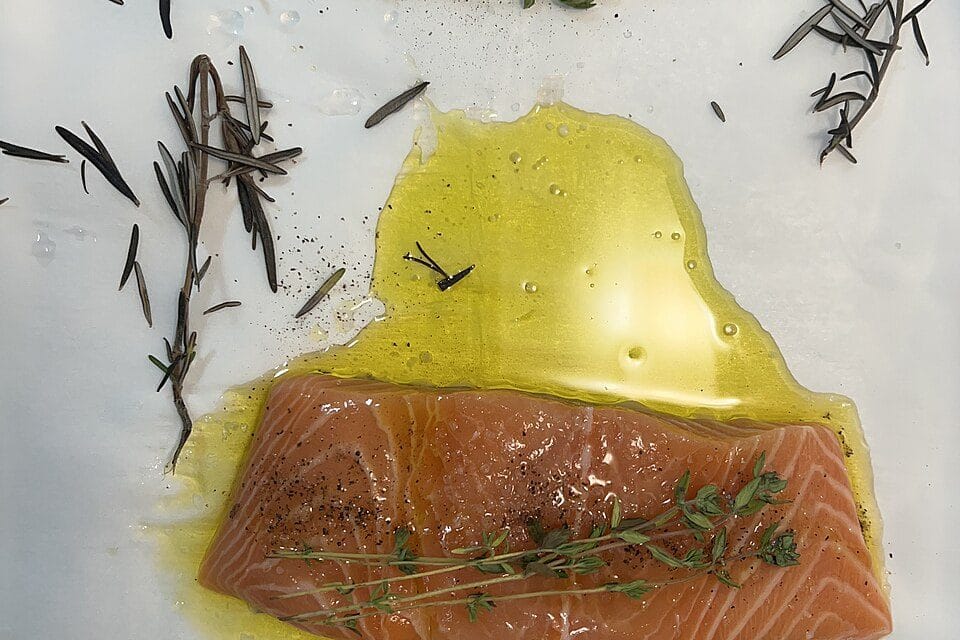
Food alone rarely closes a real deficiency, but it's worth building the habit anyway because it stacks with everything else you're doing. Fatty fish carries the most per serving — a 100g portion of wild salmon has roughly 600–1,000 IU of vitamin D3, while the same amount of farmed salmon runs lower, often closer to 250–400 IU, depending on what the fish were fed. Egg yolks contribute a modest amount, around 40 IU each, and the exact figure depends partly on whether the hens themselves had outdoor access. Mushrooms are the rare plant source, but only if they were grown under UV light rather than in the dark; check the packaging, because most supermarket mushrooms haven't been exposed to it and contain next to nothing. Fortified foods do a lot of the heavy lifting in a typical week — most UK milk and plant-based milk alternatives, plus breakfast cereals and some orange juice in the US, are fortified to roughly 100 IU per serving, which adds up fast if you're having them daily.
Sun Exposure, Realistically
Ten to fifteen minutes of midday sun on bare arms and legs, a few times a week between April and September, is enough for most fair-to-medium skin tones to make a meaningful amount of vitamin D — you don't need to sunbathe or skip sunscreen on your face to get there. The catch is timing: UVB, the wavelength that triggers vitamin D synthesis, barely reaches the ground before 10am or after 4pm at UK and northern-US latitudes, so an early dog walk or an evening run does almost nothing for your levels even in July. Darker skin tones need proportionally longer, sometimes thirty to forty minutes, to produce a comparable amount. And through autumn and winter at these latitudes, the honest answer is that sun exposure alone won't get you there — the sun angle is too low regardless of how much time you spend outside, which is exactly why supplementation is a normal, unremarkable part of the yearly routine rather than a sign something has gone wrong.
Testing and Supplementing Without Guessing
A blood test measuring 25-hydroxyvitamin D — sometimes written as 25(OH)D — is the only reliable way to know where you actually stand, and it's available through most GP surgeries in the UK (occasionally with a private top-up fee if it isn't deemed clinically necessary) and through routine bloodwork or direct-to-consumer kits in the US. Levels below 25 nmol/L (10 ng/mL) count as deficient by most clinical guidelines; 25–50 nmol/L is considered insufficient; and above 50 nmol/L (20 ng/mL) is generally adequate, though some endocrinologists argue for a higher target closer to 75 nmol/L. For maintenance, the NHS recommends 400 IU (10 mcg) daily for most adults during autumn and winter, while the US Endocrine Society's guidance for someone who tests genuinely deficient often runs to 1,500–2,000 IU daily, sometimes higher short-term under medical supervision. Don't guess your way to a high dose based on an online recommendation — get tested first, because vitamin D is fat-soluble and, unlike vitamin C, it doesn't simply flush out if you take too much for too long.
Who Should Be Careful
Vitamin D supplementation isn't universally risk-free, even though it's sold over the counter without much fanfare. People with kidney disease need medical supervision before supplementing, because damaged kidneys struggle to regulate the calcium balance that vitamin D affects, and high doses can push calcium to dangerous levels. Certain medications interact with it too — thiazide diuretics, some anticonvulsants, and long-term steroid use all change how the body processes vitamin D or calcium, so it's worth mentioning any supplement to whoever prescribes those. Granulomatous conditions like sarcoidosis are a less common but real exception, since the condition itself can cause the body to produce excess active vitamin D, and adding more from a bottle compounds the problem rather than helping it. None of that is a reason to avoid testing or supplementing if you're in the majority of women without those conditions — it's a reason to mention what you're taking at your next GP appointment rather than treating a supplement bottle as risk-free by default.